
Peacebuilding and “Development” in Colombia
“In nature's economy the currency is not money, it is life.”
― Vandana Shiva, Earth Democracy: Justice, Sustainability, and Peace
The context of the peace building that started in Colombia in 2016 with the peace agreement between the Colombia Government and FARC (1) opened the discussion about the appropriate kind of “development” that the country needs to make a transition in the territories where the war took place. There are different ways to understand our vision of future and how to create an environment of reconciliation, protect natural and cultural diversity, and create strong economies in the rural and urban areas, which are some of the principal challenges in Colombia. However, all decisions in new investments and public policies requiere enhancing the local communities knowledge regarding the effects of war.
By Jorge Andrés Forero-González*
What kind of “development” does the country need in building peace?
The question about Integral Rural Reform, the first and fourth points in the peace agreement, retaken a sixty year debate about “development” with specific political, cultural and economics practices(2). Colombia is an especially rural country (3). Cities like Bogotá D.C, with close to ten million people (4) have big rural areas, and in many large, important, and popular neighborhoods, agricultural relationships are common. Expansion of the cities has been impacted by the last few decades of war, with more than 10 million people displaced from the country. These refugees, of course, bring their cultural norms with them to the cities.
The peace agreement describes in Integral Rural Reform the importance of creating new investments to create infrastructure and bring State services to the rural areas, especially in the territories where war has taken place. This new opportunity to build a bridge between the war-torn country and the peaceful country has two strong visions. First, the government is interested in creating situations that attract private sector money to support new investments and new businesses. Second, the agreement describes the importance of making the rural communities and ethnic nations stronger, developing their economies, and making their Lives Plans and vision of future stronger to create a scenario of reconciliation.
This discussion is not new to the history of nations like Colombia; it’s the same throughout Latin America. The colonialist ideas about her future employ the concept of an inferior culture, and political and economic system. Concepts like rich vs poor countries, or developed vs. undeveloped countries determined our vision of past, present, and future. In this concept, our countries, our cultures, and our economies are categorized “inferior” and in permanent comparison with high economic countries, especially west of Europe, North America (not including Mexico), and countries in Asia such as Japan and, more recently, China. The general idea about “development” has a close relationship with the concept of dominant technology and the use of markets to the welfare of some people and the detriment of other people. However, mechanized and monetized economic activities are not superior to many kinds of technologies that many communities or countries around the world use to solve their problems (5) and that have special opportunities to solve big problems like climate warming.
Two visions of “development”
The government of Colombia under Santos (6) understood that the best environment to build legal business in Colombia would be to end the war. For example, the implementation of the peace agreement brings the opportunity to combine public and private investment in more than 170 municipalities (7) where the army conflict took place. These are municipalities that have special economic conditions and natural resources that during the war were impossible to exploit and use for big business. For that, this vision of development is announced with big investment in natural resources extraction such as petroleum, coal or gold, and big agroindustrial activities like the production of african palm and/or soy in large scale in the east of the country.
In addition, with the recently fiscal reforms and tax reduction, the government of Colombia is sending a message to transnacional private companies to invest in the country (8). This vision of development focuses on large-scale food production, using and imitating models from Brazil, The United States, and the sugar plantations in the south of Colombia, where big agribusiness corporations control the production of food, renting the land and contracting employees that do not have a cultural relationship with the land. In this vision of “development”, the government understands that peace is serving the purpose of the new infrastructure to help to attract more private capital to invest in Colombia.
In contrast, the communities that are living in the territories that have been more affected by war, understand the vision of the government and the big private sector how the cause of the war. In many of their lands the army conflict was an excuse for displacement, murders, and aggression against human rights. After one sees what happened next, an easy conclusion can be made. After violent displacement, big economic projects, that happen to be government sponsored, came into existence in many of these places (9). Of course the communities and victims of the war also demand new investments and technologies, but in the peacebuilding process, they also say that it is essential to develop and strengthen their Life Plans (10).
Life Plans are an autonomous process of the communities so they can perform their own regional planning and have their own local government based on the culture and relationships within their territories. There is a special proposal to develop local economies with an emphasis on agriculture, and the protection of sacred places, water, and biodiversity. This vision values local knowledge, and demands the presence of the state within hospitals, schools, universities, and infrastructure for roads and connectivity to develop local economies.
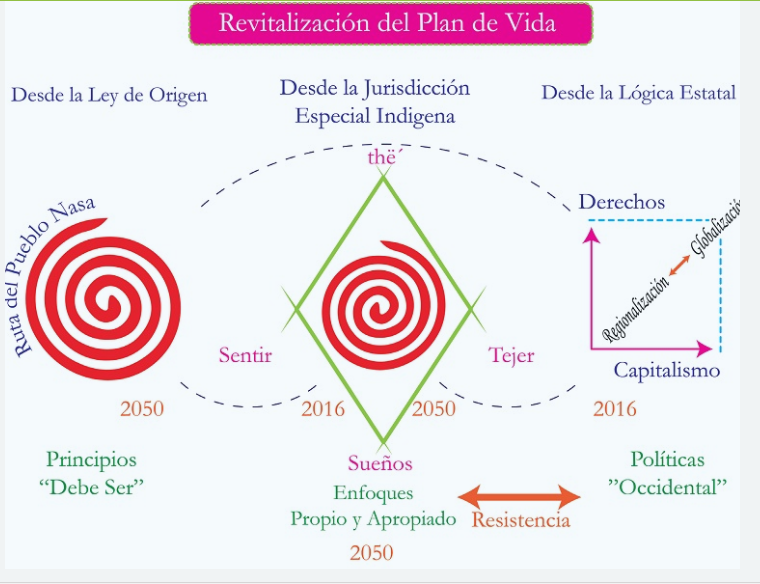
See for example: Life Plan Proyecto Nasa (Asociación de Cabildos Indígenas de Toribio, Tacueyó y San Francisco) Available in http://www.proyectonasa.org/
Life Plans are connected with global issues such as climate change. For example, agricultural production of local rural communities supply 70% of the food in the world and at the same time are protecting the environment because their farm plots are so small (11). It is easy to understand that in order to survive, the campesinas (agricultural communities), the indigenous nations and the african colombian communities and peoples need to protect their sacred places on lakes and rivers, and in the jungles and mountains, and need to prioritize food production. These type of activities are more far sustainable than mining and the impacts of giant agribusinesses that use pesticides and monoculture (12).
In comparison, perspectives of countries like Bhutan understand that economic development is recognizing that when people are happy, they are stronger advocates for conserving biodiversity (13). Other examples of this vision of sustainability can be found in the new constitutions of Ecuador (14) and Bolivia (15), that include the right of Mother Earth in a clear message to protect nature, not only to develop business. This new vision helps increase the debate in Colombia to include the protection of the territories, land, culture, and agricultural and ethnic communities .
To see the future, we need to understand the past of the war in Colombia. In the context of two visions of “development”, the new reforms to building peace will be successful if the government of Colombia agrees to strengthen the proposals of the communities while at the same time, creating scenarios of reconciliation. All new investment plans need the true participation and support of the local communities, in addition to making use of and respecting their knowledge and their life plans. This principle, which is written in the peace agreement, has not been applied with the consent of the communities during the first year of implementation, and at the same time, the government has been developing new legislation to strengthen private investment like the ZIDRES (16). The new government of Colombia under Duque should comply with the social demand for peace in Colombia and support the global agenda for giving economic alternatives to the communities in which the war took place.
The challenge about what kind of “development” and investment the country needs in the peace building process of negotiation and agreement between the government of Colombia and the communities, is a big national dialogue about the economic future in the country. Is its’ vision to deepen natural resources extraction activities and agricultural business giants, or begin to rebuild local economies and protect human, cultural, and natural biodiversity? It is clear that new investment for peace in the territories where the war took place are priorities for reconciliation, and won’t succeed in economic business without the real and concerted participation of the communities.
Finally, it is important to understand that the war in Colombia didn’t end human rights aggressions: these numbers are still astonishing. Since 2016, almost five hundred social leader have been killed. Overcoming more than 60 years of war is a big process (17). The good news is that with social justice, peace is possible, and the communities in times of war are making alternatives in their territories (18). We can use advanced technology from around the world in Colombia, and overcome our challenges with the help of the international community. Colombia ia a beautiful country, fifty million strong that want a second opportunity on the earth.(19)
“There is no 'way to peace,' there is only peace.” -Ghandi
* Jorge Andrés Forero-González is from Colombia and studied economics and political science at the National University of Colombia and the University of the Andes. He is working with Indigenous Peoples, the Afro-Colombian community in CENPAZ, and Campesinas agricultural communities in establishing processes for implementing the peace agreement. Currently, he is a Fulbright Scholar in the United States as part of the Hubert H. Humphrey Fellowship Program; 2018 – 2019.
** Editing by Miranda Mosis, MaEd., public teacher and specialist in education. Special Thanks.
NOTES:
- The Agreement have 6 Points/Items: 1. Integral Rural Reform 2. Political Participation. 3.End of the War. 4. Solution to the Drug Problem 5. System of Truth, Justice Especially for Peace, Reparation and Guarantees of No Repetition and 6. Verification and Implementation. It Was signed in November of 2016 to the Government of Colombia and FARC Revolutionary Armed Forces of Colombia. Today with the agreement FARC is a Political Party. See: Final Agreement to end the armed conflict and build a stable and lasting Peace. Available in: http://especiales.presidencia.gov.co/Documents/20170620-dejacion-armas/acuerdos/acuerdo-final-ingles.pdf
- See: The Invention of Development, Arturo Escobar. Available in: https://commons.wvc.edu/jminharo/pols101/Articles%20to%20Choose%20From/The%20Invention%20of%20Development.pdf
- See Inform of United Nations, Colombia Razones para la Esperanza in which it is presented that more that 32% of the population in Colombia is Rural. However, it may be possible to extend the concept of rurality to the cities of Colombia, creating a permanent relationship between the urban areas and the surrounding countryside. See: Colombia Razones para la Esperanza Available in http://www.undp.org/content/dam/colombia/docs/DesarrolloHumano/undp-co-ic_indh2011-parte1-2011.pdf
- 10 millions includes Bogota add other big cities and municipalities like Soacha, Chia o Zipaquira that are neighbors in a big metropolitan area.
- In words of Harry Truman President of USA in 1949, the technology and the development will be the heroes to save the poor and miserable people around the world : “I believe that we should make available to peace-loving peoples the benefits of our store of technical knowledge in order to help them realize their aspirations for a better life. And, in cooperation with other nations, we should foster capital investment in areas needing development”. See: Truman's Inaugural Address, January 20, 1949. Available in: https://trumanlibrary.org/whistlestop/50yr_archive/inagural20jan1949.htm
- Juan Manuel Santos was the president of Colombia between 2010 to 2018.
- The agreement includes special investments in new regional vision of the development around of the Plans of Development with Territory Focus - PDET. See: Final Agreement to end the armed conflict and build a stable and lasting Peace. Available in: http://especiales.presidencia.gov.co/Documents/20170620-dejacion-armas/acuerdos/acuerdo-final-ingles.pdf
- See: La reforma tributaria de Santos profundiza la desigualdad. Availavble in: https://jorgerobledo.com/la-reforma-tributaria-de-santos-profundiza-la-desigualdad/
- Some examples of the link of violence and big business are the projects that Hidroituango, see: Colombians who once fled war now forced to run from catastrophic flooding. Available in: https://www.theguardian.com/world/2018/jun/12/colombia-river-cauca-breach-flooding-farc Other examples is relative to the Bussinnes of Oil Palm and the dissaplecement of the Communities. See: Under the Oil Palm Trees. Available in: https://pbicolombia.org/2018/05/10/under-the-oil-palm-trees/
- The rural communities has many differents kinds of Live Plans accord their culture and traditions and the relationship with their territories. There are for example, Plans of life and Plans of Salvaguard of the Indigenous Peoples, Ethnic Development Black Communities Plans or Sustainable Development Plans of the Reserve Campesinas Zones.
- See: Hungry for land: small farmers feed the world with less than a quarter of all farmland. Available in: https://www.grain.org/article/entries/4929-hungry-for-land-small-farmers-feed-the-world-with-less-than-a-quarter-of-all-farmland
- See: Climate Justice and Agroecology in Southern and Eastern Africa: launch of advocacy strategies. Available in: https://viacampesina.org/en/climate-justice-and-agroecology-in-southern-and-eastern-africa-launch-of-advocacy-strategies/
- See: Tshering Tobgay: This country isn't just carbon neutral - TED Talks. Available in: https://www.ted.com/talks/tshering_tobgay_this_country_isn_t_just_carbon_neutral_it_s_carbon_negative
- See: Ecuador adopts rights of nature in Constitution. Available in: http://therightsofnature.org/ecuador-rights/
- See: Bolivia enshrines natural world's rights with equal status for Mother Earth. Available in: https://www.theguardian.com/environment/2011/apr/10/bolivia-enshrines-natural-worlds-rights
- One of the strategies with more propaganda for the government of Colombia are the Zones of Interest for Economic and Social Development in Rural Areas (ZIDRES). Recently was regulated (CONPES 3917) but have a special tradition in the link between private business, displacements of the communities and violence. See: Hope for ‘The Future’ in Colombia. Available in: https://politicsofpoverty.oxfamamerica.org/2016/12/hope-for-the-future-in-colombia/
- See: Risks in the Peace Building Process in Colombia and Challenges to the new Government. Available in: http://www.conpicolombia.org/2018/07/risks-in-peace-building-process-in.html
- See: How to return to the land after sixty years of war in Colombia?. Available in: http://www.conpicolombia.org/2018/09/how-to-return-to-land-after-sixty-years.html
- See: The Solitude of America Latina, Gabriel Garcia Marquez 1982. Available in: https://www.nobelprize.org/prizes/literature/1982/marquez/lecture/

